반응형
※ 김성훈 교수님의 [모두를 위한 딥러닝] 강의 정리
- 참고자료 : Andrew Ng's ML class
1) https://class.coursera.org/ml-003/lecture
2) http://holehouse.org/mlclass/ (note)
1. Hypothesis using matrix
- H(x1, x2, x3) = x1w1 + x2w2 + x3w3
-> H(X) = XW
2. tensorflow 구현
2-1. 기존 방법
| import tensorflow as tf |
| tf.set_random_seed(777) # for reproducibility |
| x1_data = [73., 93., 89., 96., 73.] |
| x2_data = [80., 88., 91., 98., 66.] |
| x3_data = [75., 93., 90., 100., 70.] |
| y_data = [152., 185., 180., 196., 142.] |
| # placeholders for a tensor that will be always fed. |
| x1 = tf.placeholder(tf.float32) |
| x2 = tf.placeholder(tf.float32) |
| x3 = tf.placeholder(tf.float32) |
| Y = tf.placeholder(tf.float32) |
| w1 = tf.Variable(tf.random_normal([1]), name='weight1') |
| w2 = tf.Variable(tf.random_normal([1]), name='weight2') |
| w3 = tf.Variable(tf.random_normal([1]), name='weight3') |
| b = tf.Variable(tf.random_normal([1]), name='bias') |
| hypothesis = x1 * w1 + x2 * w2 + x3 * w3 + b |
| # cost/loss function |
| cost = tf.reduce_mean(tf.square(hypothesis - Y)) |
| # Minimize. Need a very small learning rate for this data set |
| optimizer = tf.train.GradientDescentOptimizer(learning_rate=1e-5) |
| train = optimizer.minimize(cost) |
| # Launch the graph in a session. |
| sess = tf.Session() |
| # Initializes global variables in the graph. |
| sess.run(tf.global_variables_initializer()) |
| for step in range(2001): |
| cost_val, hy_val, _ = sess.run([cost, hypothesis, train], |
| feed_dict={x1: x1_data, x2: x2_data, x3: x3_data, Y: y_data}) |
| if step % 10 == 0: |
| print(step, "Cost: ", cost_val, "\nPrediction:\n", hy_val) |
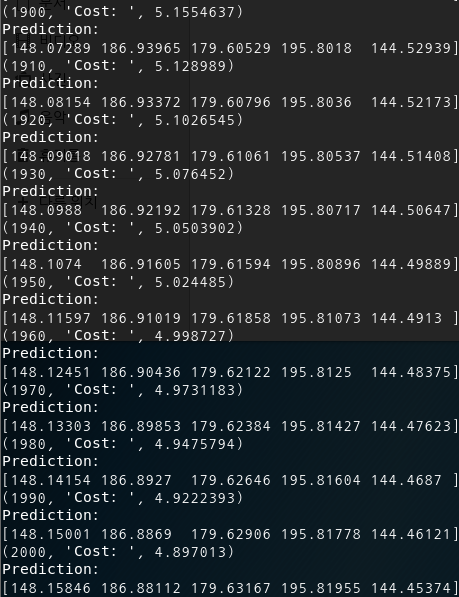
2-2. matrix 이용
| import tensorflow as tf |
| tf.set_random_seed(777) # for reproducibility |
| x_data = [[73., 80., 75.], |
| [93., 88., 93.], |
| [89., 91., 90.], |
| [96., 98., 100.], |
| [73., 66., 70.]] |
| y_data = [[152.], |
| [185.], |
| [180.], |
| [196.], |
| [142.]] |
| # placeholders for a tensor that will be always fed. |
| X = tf.placeholder(tf.float32, shape=[None, 3]) |
| Y = tf.placeholder(tf.float32, shape=[None, 1]) |
| W = tf.Variable(tf.random_normal([3, 1]), name='weight') |
| b = tf.Variable(tf.random_normal([1]), name='bias') |
| # Hypothesis |
| hypothesis = tf.matmul(X, W) + b |
| # Simplified cost/loss function |
| cost = tf.reduce_mean(tf.square(hypothesis - Y)) |
| # Minimize |
| optimizer = tf.train.GradientDescentOptimizer(learning_rate=1e-5) |
| train = optimizer.minimize(cost) |
| # Launch the graph in a session. |
| sess = tf.Session() |
| # Initializes global variables in the graph. |
| sess.run(tf.global_variables_initializer()) |
| for step in range(2001): |
| cost_val, hy_val, _ = sess.run( |
| [cost, hypothesis, train], feed_dict={X: x_data, Y: y_data}) |
| if step % 10 == 0: |
| print(step, "Cost: ", cost_val, "\nPrediction:\n", hy_val) |

반응형
'Deep Learning' 카테고리의 다른 글
| [머신러닝/딥러닝] Logistic (regression) classification 구현하기 by TensorfFlow (0) | 2019.12.04 |
|---|---|
| [머신러닝/딥러닝] 파일에서 Tensorflow로 데이터 읽어오기 (0) | 2019.12.02 |
| [머신러닝/딥러닝] Linear Regression의 cost 최소화의 Tensorflow 구현 (0) | 2019.11.21 |
| [머신러닝/딥러닝] TensorFlow로 간단한 linear regression 구현 (0) | 2019.11.21 |
| [머신러닝/딥러닝] Tensorflow 설치 및 기본 동작원리 (0) | 2019.11.19 |


